
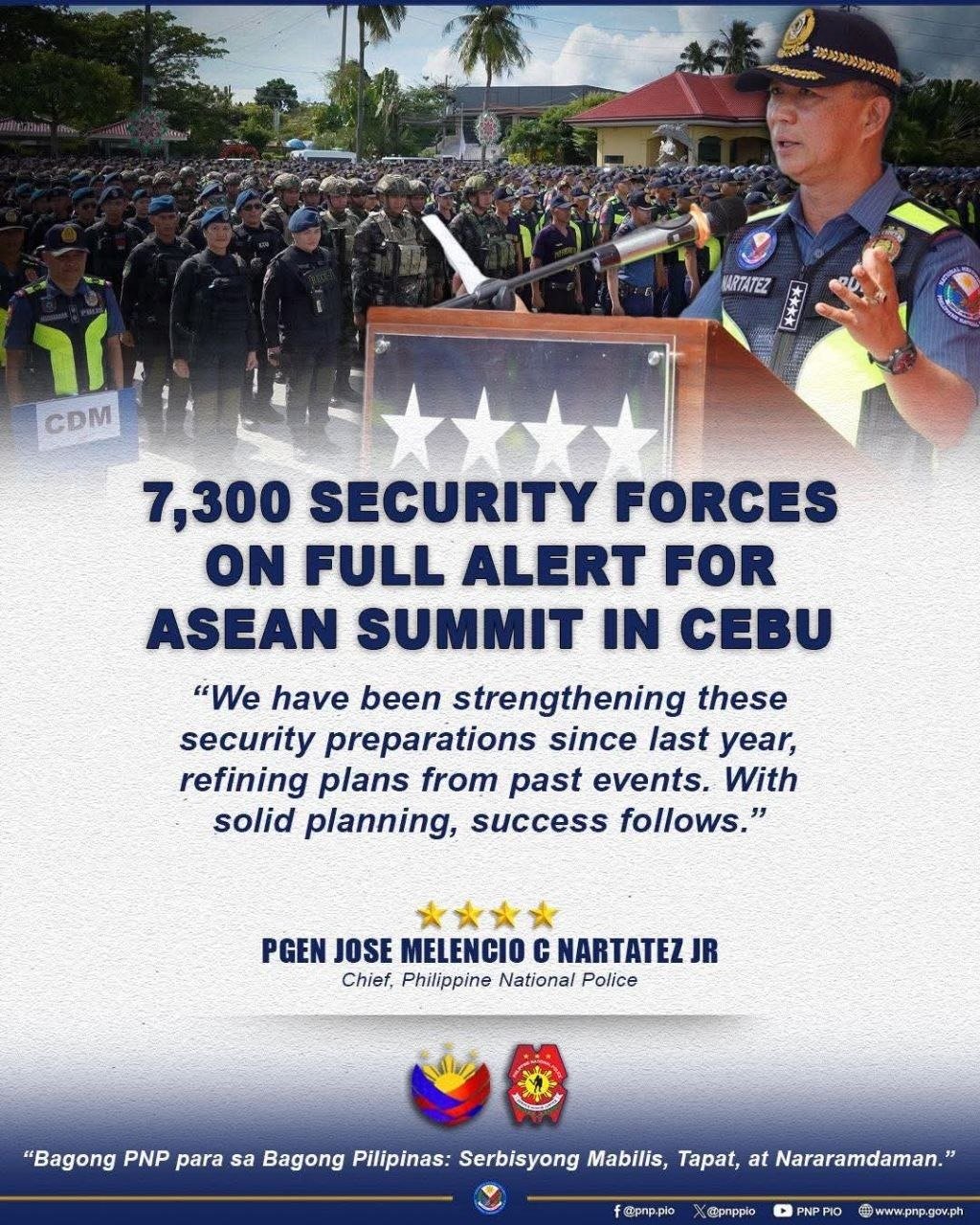
The Philippine government has put its full security apparatus into motion for the 48th ASEAN Leaders’ Summit 2026, formally launching the deployment of more than 10,200 personnel drawn from multiple government agencies during a ceremony held at the historic Mactan Shrine in Lapu-Lapu City last Saturday, May 2, 2026. The event marked a critical milestone in preparations for one of the country’s most consequential diplomatic hosting duties in recent memory.
Send-Off Rite Launches Unified Security Command
The formal send-off ceremony served as the occasion for the official activation of Task Group Central Visayas, the unified multi-agency security body operating under the Committee on Security, Peace and Order, and Emergency Preparedness and Response, known by its acronym CSPOEPR. With its activation, the task group now serves as the central coordinating body overseeing all security-related operations for the two-day regional summit.
Philippine National Police Chief, Police General Jose Melencio C. Nartatez Jr., presided over the ceremony together with members of the PNP Directorial Staff and senior officials from national and regional government. The gathering signaled the full operationalization of a security framework that has been months in the planning.
The choice of Mactan Shrine as the venue was far from incidental. The site is historically significant as the location where Lapu-Lapu and his warriors defeated Portuguese explorer Ferdinand Magellan in 1521 — an event widely regarded as a symbol of Filipino courage and resistance. Officials drew a deliberate parallel between that legacy of valor and the nation’s readiness to welcome world leaders to its shores.
Scope of Deployment and Security Coverage
The massive security mobilization encompasses personnel from the Philippine National Police, Armed Forces of the Philippines, Bureau of Fire Protection, Philippine Coast Guard, Department of Health, and Office of Civil Defense, among others. Together, these agencies form an integrated security network covering virtually every dimension of the summit’s operational requirements.
According to the PNP, the deployment addresses a wide range of security functions: venue protection, convoy security, coastal patrol and airspace surveillance, traffic control and management, emergency medical response, and rapid-reaction capabilities for any unplanned incidents. Foreign delegates are expected to begin arriving as early as May 5, with departures extending until May 12, while the summit itself is scheduled for May 7 and 8.
Col. Arthur M. Romanillos Jr., representing the Visayas Command or VISCOM, underscored that the event’s success rests on seamless coordination across every participating agency. He stressed that security, public order, and emergency preparedness are collective responsibilities that require precise communication and synchronized action from all units involved.
PNP Chief Conducts Aerial Inspection of Key Sites
Prior to the ceremony, PNP Chief Nartatez conducted an aerial survey over critical areas in Central Visayas to personally assess the state of operational readiness. The inspection allowed him to validate deployment configurations, review transport corridors, and confirm coordination protocols across event venues and surrounding areas.
“This operation is the result of extensive planning and sustained coordination, drawing from established best practices in previous national and international events. We are fully prepared to ensure a safe and secure ASEAN Summit,” Nartatez said in his address during the send-off ceremony.
The PNP chief further noted that the number of deployed personnel was deliberately calibrated to match specific operational requirements, ensuring optimal coverage without unnecessary redundancy throughout the duration of the summit.
Senior Officials Represent Broad Government Support
The send-off ceremony drew high-ranking representatives from across government, reflecting the broad institutional support behind the security preparations. Among those present were Gen. Potenciano Camba of the Office of the Director General for Operations, Lapu-Lapu City Mayor Maria Cynthia K. Chan, and RADM Agapito Bibat of the Philippine Coast Guard.
From the military side, the ceremony was attended by BGen. Sheila Grace Vicente of the Philippine Air Force, BGen. Joel N. Sobrera of the Philippine Army’s 53rd Engineer Brigade, and Commo. Joselito E. De Guzman of Naval Forces Central.
Civilian agency representatives were equally prominent. These included FCSUPT Fred L. Trajeras of the Bureau of Fire Protection Regional Office 7, Ms. Gelana N. Asis-Dimpas of the Department of Tourism Region 7, Dr. Joshua G. Brillantes of the Department of Health Regional Office 7, Director Joel Q. Mamon of the Office of Civil Defense Regional Office 7, and Regional Director Shalane Marie S. Lucero of the Department of Social Welfare and Development.
PNP Transformation Framework Anchors the Operation
The security operation is guided by the PNP Focused Agenda, a transformation framework designed to make police service more responsive, operationally efficient, and attuned to the needs of the communities it serves. Central to this framework is the principle of intelligence-driven operations and strengthened coordination with partner agencies.
The deployment operates under a directive from President Ferdinand R. Marcos Jr., tasking the PNP to lead comprehensive security preparations for the summit. Officials have publicly committed to upholding the principle encapsulated in the slogan: “Bagong PNP para sa Bagong Pilipinas: Serbisyong mabilis, tapat, at nararamdaman” — reflecting the administration’s vision of a reformed, people-centered police force.
Summit Agenda and Regional Significance
The 48th ASEAN Leaders’ Summit is expected to bring together heads of state and government from across Southeast Asia to deliberate on pressing regional concerns, including security cooperation, trade and economic integration, and collaborative policy development. For the Philippines, hosting the summit carries considerable diplomatic weight as a demonstration of the country’s capacity to manage complex, high-profile international events.
Central Visayas serves as the host region, with Lapu-Lapu City designated as the primary venue for the gathering. The region’s selection reflects both its logistical capacity and its symbolic resonance as home to one of the Philippines’ most celebrated historical landmarks.
All Systems Set for the Summit
With the formal activation of Task Group Central Visayas, officials emphasized that preparations now span every major operational domain — security, public safety, emergency medical response, traffic management, tourism support, logistics, and social welfare services. The comprehensive scope of the deployment reflects the government’s awareness of the summit’s significance not only as a security challenge but as a statement of national capability.
At over 10,200 personnel, this ranks among the largest multi-agency security deployments ever mounted for an international event on Philippine soil. As the summit’s opening approaches, the ceremony at Mactan Shrine stands as a firm declaration that Central Visayas — and the Philippines as a whole — is ready to deliver a safe, orderly, and successful 48th ASEAN Leaders’ Summit 2026.
Photo credit: PNP